Editor's Note [Volume 22 No. 8 (2022)]
Right to Food Movement
In September 2022 I had the chance to visit the state of Jharkhand in India, one of the states where the Right to Food Movement took root. It was incredible to hear firsthand from those who were in the campaign and visit rural communities that benefit from the National Food Security Act, thanks to the tireless efforts of the movement.
The Indian Right to Food Act is mainly based on welfare. There are many welfare programs in India, covering up to 75% of the rural population and 50% of the urban population in India. The Act was quite ambitious as it turned existing food security and welfare programs into legal entitlements. The legal provisions in the NFSA include the Public Distribution System- a food rations distribution program, Integrated Child Development Scheme, Midday Meal program for school feeding, Employment Guarantee Act (2005) providing at least 100 days of wage employment per year to one member of a household, and Pension entitlements.
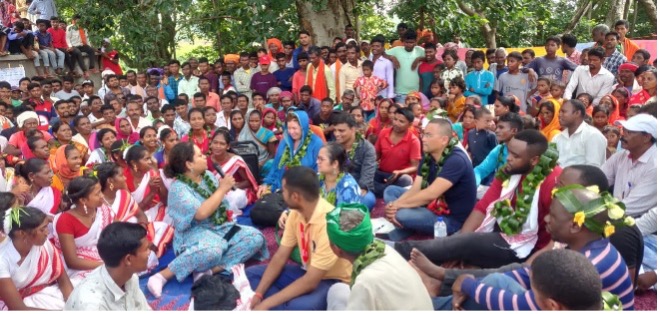 Photo of a Gram Sabha- a community assembly – in Baraitu village, Latehar district in Jharkhand, India |
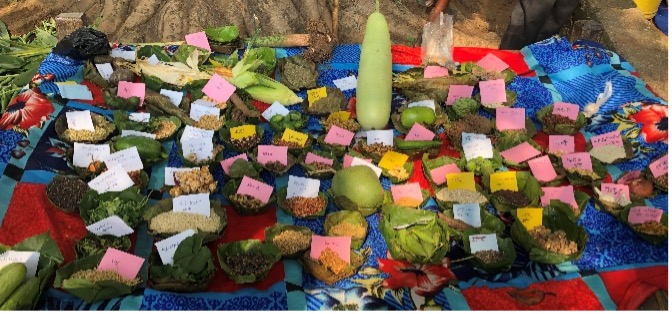 An exhibition of indigenous foods in Kutmu village, Latehar district in Jharkhand, India |
We learned that the provisions are publicly financed, only taking up 0.5% of the country’s GDP. As much as we were amazed by this achievement, our Indian colleagues were quick to remark that getting a law passed is the easy part. The hard work begins in the implementation, monitoring, and updating of entitlements.
This got me thinking, how do we secure gains made in food security, nutrition, climate, and research? And how do we adjust in the face of increased malnutrition, hunger, poverty, climate change, recession, conflict, and at the same time limited demonstrated political will?
In the Horn of Africa, we are facing the worst drought since 1928. It seems to get worse. There are no indications that the Government intends to tackle any differently from the way it has done in the past, that is, through donor support.
From what I see as successful cases, local action was central to securing progressive policies that deliver on food security, food safety, and food sovereignty. Both grassroots movements and civic action, for example, referenda are used to counter classical high-level lobbying used by industry and multinationals.
Increasingly citizens are voicing out their opinions on food choices and how their food should be produced. This is in effect transforming food systems and markets considerably. Some examples include the organic food movement, the preference for indigenous healthy food, and others.
We need ideas on how to address these issues. Please share.
In this issue, we present 16 well-reviewed manuscripts. We congratulate the authors and our dedicated team of reviewers for a great job done. I wish you pleasant reading of issue 113.
If you wish to offer a commentary, please contact the Editor-in-Chief.
Njeri Karanu
Assistant Editor-in-Chief, AJFAND
knjeri2003@gmail.com